Reviews and features
Positives are the acting from the ensemble cast, characterisation and atmosphere. Some criticisms are that the narrative can get repetitive and the structure and pace.
2) What references can you find in the reviews and feature to the idea Capital is a 'state-of-the-nation' drama? How does it capture modern-day London?
One of Capital's biggest themes is about the housing prices which relate to the idea of a 'state-of-the-nation' drama.
Trailer analysis
Watch the trailer for Capital:
1) How does the drama use camerawork to capture London life?
Establishing shot of the road name and the street itself.
2) How does the trailer introduce the different narrative strands suggesting tension or enigma in the 40-second running time?
It has multiple back to back shots of different characters which shows off the ensemble cast illustrating the multiple narratives the audience will likely follow.
Capital in Media Magazine
Issue 83 of Media Magazine has a feature exploring Capital as a media product. Read ‘We Want What You Have’ in MM83 (p10). You'll
find our Media Magazine archive here - remember you'll need your Greenford Google login to access. Answer the following questions:
1) What does the article suggest about the 'state of the nation' genre and how Capital is an example of this?
Such novels try to represent an entire country at a particular moment in time. As such, they involve multiple story lines and a large cast. It’s tricky for a television adaptation to have such lofty ambitions, given limitations imposed by production costs and schedules.
2) What does the article suggest regarding the setting of Capital?
Setting the drama entirely in the capital city might enrage those who see the UK as being too London-centric, but it makes sense in the context of a multi-stranded production. Centring the action on a single street then helps bring some focus to the narrative.
3) What are the major themes in Capital and what does the article suggest regarding the impact of money on communities?
Housing prices, immigration. Thematically, it seems that money is breaking up the community and, by extension, breaking up social bonds up and down the country.
4) What different representations in Capital are discussed in the article?
It’s easy to see why a banker would play a central role in a state-of-the-nation drama set at this time, given the massive impact of the financial crash in 2008.The representations of good versus bad, rich versus poor and industrious versus feckless make for straightforward drama.
5) What does the final section of the article suggest regarding genre and overall message of the drama?
Capital is a state-of-the-nation drama, but its opening sequence draws on the crime genre. The shadowy hooded figure, mentioned above, is shot in grainy, handheld footage. Their presence sets up an enigma. Framing a state-of-the-nation drama with this crime element helps to hold the viewer’s attention. But it also has an artistic purpose. All of our lives are framed by a hidden, sinister force, one that the drama clearly identifies as capital (in the money sense).
Capital Media Factsheet
Use our Media Factsheet archive on the M: drive Media Shared (M:\Resources\A Level\Media Factsheets) or
on Google Drive here (you'll need your Greenford Google login) to find Media Factsheet #194 on Capital (BBC TV Drama).
Read the whole of Factsheet and answer the following questions:
1) What does the factsheet say about the characters on the first page?
The characters also demonstrate the state-of-the-nation aspect of this drama. Episode 1 focuses on Petunia Howe and Roger and Arabella Yount . We are also introduced to the Kamal family, who run the corner shop, and Quentina Mkfesi, a religious asylum seeker with a PhD working illegally as a traffic warden. The interactions between the characters reflect the tensions between different cultures and costume is used to quickly communicate the different character roles.
2) Focusing on the industrial contexts, how does Capital help the BBC meet its obligations as a public service broadcaster?
The BBC are primarily funded by the licence fee, and has a set of values and public purposes that govern the content that is produced. Fundamentally the BBC seek to educate, inform and entertain.
3) What do we learn about the ownership structure for production company Kudos?
Kudos specialises in TV series which can be sold or remade for the US market, making it typical of contemporary media institutions which operate globally rather than nationally. The ownership of Kudos reflects a horizontally integrated company. The parent company, Endemol Shine UK, own a range of TV production companies across different formats and genres. Endemol Shine UK is owned in equal share
Apollo Global Management (an American public equity firm) and 21st Century Fox. 21st Century Fox is owned by the Murdoch family, and was established in 2013 as a spin-off for the film and TV aspects of News Corporation. News Corporation was split following a series of scandals in British press.
4) How can David Hesmondhalgh's ideas in The Cultural Industries be linked to Capital and Kudos? Hesmondhalgh suggests that media companies are a 'risky business' so Kudos uses horizontal integration to decrease the risk.
5) How does the factsheet suggest Capital meets the genre conventions of crime and social realism?
Capital fits well within these two genres, and uses generic conventions from both areas. Examples of crime are; enigma narrative, resolution of mystery, question of morality, power struggles and more. Examples of social realism are; represent regions of UK authentically, triumph over adversity, humour and narrative intertwined in the narrative and more.
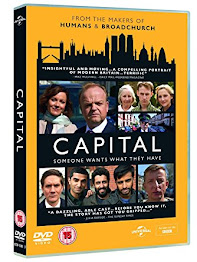
6) How does the factsheet analyse the DVD packaging and what this communicates to the audience?
The silhouette skyline of London contains clear geographical markers that denote the setting, and also establish the themes of British culture and financial issues (as both the Houses of Parliament and the Gherkin are featured). The reference to Kudos’ previous productions serves to give credibility to the TV drama and is designed to appeal to audiences who may not be familiar with the BBC (this DVD can be purchased globally). The layout of the characters on the cover carries a connotation to the crime drama, with medium close-up shots of DI Mills, The Kamal family and Bogdon.
7) Look at page 5 of the factsheet. Choose one of the audience theories in the table and apply it to Capital.
Uses and gratifications (Blumler and Katz):
-Surveillance- A modern audience can have an insight to the housing prices of London.
-Diversion- The dramatised versions of reality can be an escape for an audience.
-Personal relationship- The audience can get pleasure from watching the different relationships between the characters with a sense of being behind closed doors and watching it.
-Personal Identity- There is an ensemble cast that is diverse which means many audience members are able to view themselves a character.
8) What does the factsheet suggest regarding binary oppositions in Capital?
The multi-stranded narrative uses binary oppositions throughout to highlight the difference or inequality in Pepys Road, and then raise questions about inequality in London more widely. The character of Roger Yount is a clear example of this. During his own narrative development, we see binary oppositions within his own character (the money driven banker starts to yearn for a life with more meaning). We also see the financial inequalities through Roger and Arabella. Their initial highly stereotyped dialogue (“How do you feel about cedar wood cladding?”) serves to position the audience to understand the change in society and the Pepys Road community from ‘normal’ residential street to million-pound properties.
Representations: close-textual analysis
1) Write an analysis of the representations in each of the key scenes from episode 1 we studied in the lesson:
Scene 1: opening sequence 00:30 – 4.49
-Diversity of London - importance of immigration to London’s recent history
-Price of houses making Londoners “millionaires”
-Conventional representation of a British family life - working class / lower-middle class.
-Flashback sequence example of montage editing - nostalgia.
-Kamal family presented as contrast to Petunia’s British family - they are very close-knit, all live together.
-“Albert didn’t much care for change”.
-Eastern European immigration is shown in the opening scene when the builders walk past
Scene 2: work in the City 6.28 – 8.10
-Drone shot bird’s eye view of the city of London - the financial heart of the capital. Camerawork emphasises the wealth and power of London.
-Fast-paced editing emphasises the pace and excitement of London and working in London.
-Lack of representation of women in the financial services workplace/environment.
-Construction of the shot in Roger’s boss’s office emphasises power - view of London through window behind him.
-Roger’s boss is German - another aspect of London immigration in 2015 (Europeans moving to London to take high-paying jobs in financial services).
Scene 3: “Which of those isn’t absolutely essential?” 14.00 – 15.35
-Traditional gender stereotypes and family set up - Roger is main breadwinner, Arabella talking about how to spend the money.
-“You’d be surprised at how little £1m covers these days.” Shows how privileged the richest Londoners are
-“Name one of those things that isn’t absolutely essential.”
Scene 4: asylum 18.03 – 19.42 AND 31.10 – 32.40
-Quentina narrative emphasises the opposite side of London compared to Roger
-Sound bridge while walking to church.
- Black female lawyer - representation subverts usual picture of lawyers in media.
-Contrast between life for white people in London compared to black people in London.
-Quentina's narrative emphasises the inequality at the heart of London where she earns £300 - “I worked overtime” - but only takes £200 home.
Scene 5: “What use is 30 grand?” 36.40 – 39.00
-Editing - sped up commute to show Roger’s disorientation and losing touch with reality
-Roger completely destroyed by 30 grand bonus shows his white privilege laid bare.
-“There is a context to this… Swiss subsidiary” - shows global nature of finance industry / global capitalism.
Scene 6: life at the corner shop 40.10 – 42.55
-Scene with Arabella in corner shop - clear she has never been in that shop before, Ahmed doesn’t realise she lives in same street. Shows disconnect in London.
-Closeness of the Kamal family is such a contrast to Roger and Arabella and their reaction to a 30 grand bonus.
-Representation of race/ethnicity: “White people have no idea!” Shows how out of touch Arabella is compared to most people.
-Social class - Arabella doesn’t know how to react when Kamal family provide coriander for free. Working class values of helping out a neighbour seem completely alien to Arabella. Reflects the difference between rich and poor - emphasises the negative representation of the rich.
2) How does Capital use stereotypes? Do the characters and issues represented in Capital reinforce or subvert the stereotypes we typically see in the media?
Overall Capital both subverts and reinforces stereotypes. They reinforce traditional family values with the flashback of Petunia's life where she is in a heteronormative marriage where they have children and she is seen to be domestic whilst her husband is the breadwinner, which is the stereotypical roles of each gender. They also play into other stereotypes of the Pakistani family owning the corner shop and Quentina working illegally. They subvert stereotypes too since Roger's boss is German which is not the typical representation for a high-up banker because stereotypically they would be British or American.
Industries and production context
Capital was produced by independent production company Kudos for the BBC. Look at the Kudos website and also read the Kudos Wikipedia page.
1) Who is the parent company for Kudos? What changes of ownership have there been for Kudos? This is an example of conglomerate ownership. The parent company for Kudos is Endemol Shine Group also was owned by Banijay ownership.
2) Watch the showreel on the Kudos website. What other TV dramas have Kudos produced and for which channels? What awards have they won? Then you run, SAS rouge heroes, Tin star ect. BBC one, amazon prime, channel 4 ect.
BBC's remit is to educate, inform and entertain and Capital can be argued to do all three depending on who is viewing it.

Comments
Post a Comment